Skip to content

Using Dingo with Cardano CLI

Dingo is a Cardano blockchain node written in Go which actively participates in network communications on the Cardano blockchain using the Ouroboros Network Node-to-Node family of mini-protocols.

⚠️ Dingo is a work in progress and is currently under heavy development


In this guide, we will walk you through downloading and running the Cardano CLI binary, then demonstrate several Cardano CLI commands. To get started follow the steps below.


✅ This guide we assumes you have already downloaded Dingo and synced the blockchain. If not, see our Quick Start guide.


Step 1 - Download the latest Cardano CLI binary

Section titled “Step 1 - Download the latest Cardano CLI binary”

First, go to the Cardano CLI repo https://github.com/IntersectMBO/cardano-cli/releases page.

You can either download the binary and move the file to your preferred location or…


Copy the download URL for the latest Cardano CLI binary and run the following command:


⚠️ For this example we place the cardano-cli binary in our ~/dingo directory. Adjust the link path to the correct path for the version you want to download.

cd ~/dingo
wget https://github.com/IntersectMBO/cardano-cli/releases/download/cardano-cli-11.0.0.0/cardano-cli-11.0.0.0-x86_64-linux.tar.gz -O - | tar -xz


Step 2 - Rename the Cardano CLI Binary and Set Execute Permissions

Section titled “Step 2 - Rename the Cardano CLI Binary and Set Execute Permissions”

To make the file executable run the following command:

chmod +x cardano-cli-x86_64-linux

For this example, we will rename the binary to cardano-cli and move it to /usr/local/bin/:

⚠️ Adjust the file path and file name if needed.

sudo mv cardano-cli-x86_64-linux /usr/local/bin/cardano-cli


Congratulations! You can now use cardano-cli to communicate with your Dingo node.

Section titled “Congratulations! You can now use cardano-cli to communicate with your Dingo node.”

Step 3 - Run Cardano CLI Command to Query Tip

Section titled “Step 3 - Run Cardano CLI Command to Query Tip”

Let’s run our first Cardano CLI command to query the tip of the Preview network using the Dingo node.

Run the following command to query the tip:

./cardano-cli query tip \
--testnet-magic 2 \
--socket-path dingo.socket

⚠️ Please note: The --socket-path shown above assumes you downloaded cardano-cli into your ~/dingo directory. If you installed cardano-cli elsewhere, adjust the path accordingly. You can use realpath dingo.socket to determine the absolute path to dingo.socket.

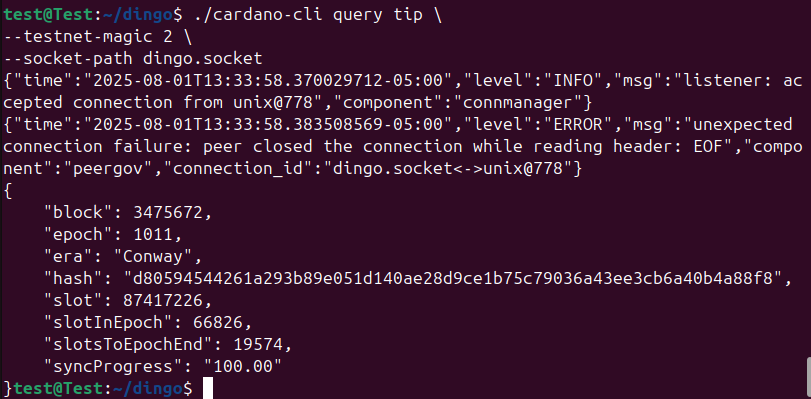
dingo-query-tip


Step 4 - Using Environment Variables (Optional)

Section titled “Step 4 - Using Environment Variables (Optional)”

Instead of specifying the Cardano network and node socket each time you run a cardano-cli command, you can use environment variables.


Setting Environment Variables for Current Session (Option 1)

Section titled “Setting Environment Variables for Current Session (Option 1)”

Run the following commands to export the variable for our current session.

Socket Path:

export CARDANO_NODE_SOCKET_PATH=~/dingo/dingo.socket

Node Network:

export CARDANO_NODE_NETWORK_ID=2

Setting Environment Variables Permanently (Option 2)

Section titled “Setting Environment Variables Permanently (Option 2)”

To make an environment variable persistent across sessions, you need to add it to your shell’s configuration file.

Socket Path:

echo export CARDANO_NODE_SOCKET_PATH=~/dingo/dingo.socket >> ~/.bashrc

Node Network:

echo export CARDANO_NODE_NETWORK_ID=2 >> ~/.bashrc


💡 Tip: Below are the current Network IDs

# SanchoNet testnet
export CARDANO_NODE_NETWORK_ID=4
# Preview testnet
export CARDANO_NODE_NETWORK_ID=2
# Pre-production testnet
export CARDANO_NODE_NETWORK_ID=1
# Mainnet
export CARDANO_NODE_NETWORK_ID=mainnet


Congratulations! You are now ready to use your Dingo node with the Cardano CLI!

Section titled “Congratulations! You are now ready to use your Dingo node with the Cardano CLI!”

Learn more about the Cardano CLI at https://developers.cardano.org